1 General and 0.5 Ethics CEUS
Ethics, Assent, and Self-Advocacy: Turning Refusal Into Communication
Turning Refusal into Communication
For BCBAs® who want to stop choosing between ethics and progress—and need a plan for what happens after assent is withdrawn. When a learner says no—subtly or clearly—you don’t lose instructional time. You gain information.
Tired of This Moment?
The RBT® is pairing. Goals are embedded. The environment is busy but manageable. Then you see it.
X The learner angles away.
X Materials get pushed aside.
X They leave the area.
The RBT® freezes—caught between “honor assent” and “don’t let them escape.” They default to first-then. They block the exit. Or they end the activity and never return to the target again.
And now you’re stuck with the real problem:
When assent is withdrawn, what do you do next—right then?
If this keeps happening, the cost isn’t theoretical:
✔ RBTs learn that honoring assent ends teaching
✔ You become the decision-maker in every hard moment
✔ Ethical values erode under pressure from data, parents, and funders

The Shift This Course Teaches
Assent-based practice isn’t about stopping instruction. And it isn’t about letting learners “get out of work.”
Refusal isn’t the barrier to learning.
Refusal is the beginning of ethical teaching—if you know how to respond.
This course gives you a repeatable decision-making system for responding to assent withdrawal without power struggles, stalled goals, or compliance creep. This is not a values talk or a theory-only ethics course. It’s a practical framework for keeping teaching moving forward while protecting dignity, trust, and long-term outcomes.
What you will learn:
Build a parent training system that families ask for — without adding hours to your week.

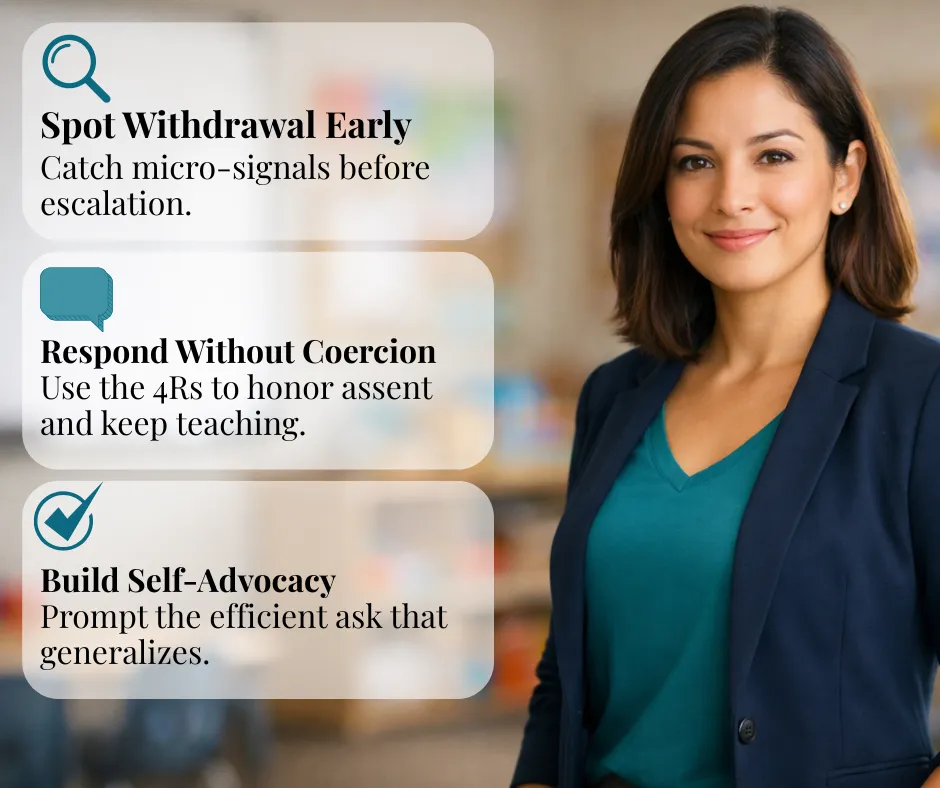
How to recognize early assent withdrawal before escalation
So you can respond to meaningful precursors instead of waiting for problem behavior.

How to decide when to remove, soften, or hold a demand
Without defaulting to escape extinction or abandoning the goal entirely.

How to reinforce communication—not compliance
So learners don’t have to escalate to be heard.

How to teach self-advocacy that actually works in the moment
Using simple, efficient responses learners can access under stress.

How to re-enter instruction without power struggles
By modifying one variable at a time instead of starting over.

How to coach RBTs® through these decisions consistently
So ethical practice doesn’t depend on confidence, memory, or supervision timing.
Why I Created This Training
I’ve trained RBTs® to “honor assent”—and then watched them freeze when it actually happened.
Because here’s the truth:
✔ Most of us were trained in systems where compliance worked.
✔ It was efficient. The data looked clean. And no one questioned it.
✔ But when I started watching sessions through the learner’s experience, I saw the gap.
We were telling staff what to value—but not what to do next. So I built a system that:
✔ Gives clear cues in chaotic moments
✔ Reinforces ethical decisions instead of punishing them
✔ Turns withdrawal into usable data, not a dead end
That system became this course.
What You’ll Walk Away With
The 4R Framework
A practical training on responding to assent withdrawal using a clear, four-step framework. So staff know exactly what to do when a learner says “no”—without freezing or forcing.
Recognize
Recognize early withdrawal (turn-away, push-away, pause). Treat these as data, not “noncompliance.”
Remove
Remove or soften the aversive element when possible; when safety or required tasks limit removal, increase control and reduce response effort.
Reinforce
Reinforce precursor communication and teach the efficient, functional ask (break, different materials, less work, different timing).
Return
Return to instruction with one purposeful modification (materials, length, format, setting, staff, timing, or SD) and track approach/withdrawal to find the fit.
Your Complete Toolkit for Ethical, Inclusive Parent Training
(Limited-Time Offer – Don’t Miss Out!)
Total Value: $135
Your Price Today: Only $30
💡What You’ll Get When You Enroll:
Ethics, Assent, and Self-Advocacy: Turning Refusal Into Communication (1 General and 0.5 Ethics CEUs)
A practical framework for responding when learners disengage—without escalation, coercion, or abandoning instruction.
The 4 Rs Response Framework
A simple, teachable system (Recognize → Remove → Reinforce → Return) for real-time decision-making.
Assent & Withdrawal Tracking Tools
Turn subtle learner behavior into usable data you can defend.
Implementation Workbook
Apply the framework directly to your learners, programs, and supervision.
Teaching Self-Advocacy Responses Guide
Go beyond “break” and build functional communication that actually replaces escalation.
Who is this for?
✔ BCBAs® supporting RBTs® who default to momentum, first-then, or blocking when things get hard.
✔ Home- and school-based clinicians navigating competing contingencies (parents, teachers, insurers) while protecting dignity.
✔ Supervisors who want clean, ethical “return” procedures instead of dropping targets for the day.
✔ Anyone ready to replace coercive patterns with collaborative, data-informed instruction.
What BCBAs® Are Saying about This and Other Master ABA Courses

Interesting subject and have not seen other classes covering this topic in detail
William Y, BCBA
(Breaking the 30-Hour Myth)
This is an exceptionally helpful course laid out in clear instructions with real-world examples. Highly recommend!
Natalie Y, BCBA
Great speaker, and was presented very well—clear, concise.
Kristy P, BCBA
Relevant, well explained, great resources.
Susan T, BCBA
Don't wait to get the tools you need to make your job easier!
Your Instructor: Amelia Dalphonse, MA, BCBA
Amelia Dalphonse, MA, BCBA, brings over 13 years of expertise in Applied Behavior Analysis and a passion for creating meaningful change. As co-founder of Master ABA and an Authorized Continuing Education (ACE) provider, she’s helped countless professionals master actionable strategies for promoting independence.
Amelia’s teaching style focuses on practical, client-centered care, blending research with real-world application.

What to Expect in This Course
Will this make kids “run the show”?
No. You’ll hold necessary boundaries and still reinforce communication. The 4R framework re-enters instruction with one targeted modification so goals continue—without power struggles.
What about safety or required tasks (e.g., classroom work, seatbelts)?
Safety isn’t optional. When removal isn’t possible, you’ll soften demands, increase control, and teach the efficient ask—then return to instruction with a modified element.
Can I still meet insurance expectations for progress and data?
Yes. You’ll collect approach/withdrawal data and use brief scatterplots to explain timing effects, plus “return-step” data to show engagement gains and progress.
Do I need prior PFA/SBT training?
No. This course borrows principles (functional communication, enhanced choice) but stays practical for typical home/school cases.