1 Free General CEU
Persistent Error Patterns and Discrimination Learning: What, why, and how
Diagnose the real reason your clients aren’t progressing — and learn how to fix it.
A Recorded Webinar with Ennio Cipani, Ph.D.
Webinar Details
Date: Wednesday, March 4, 2026
Duration: 1 hour
CEUs: 1 General CEU
Asynchronous Event: Register now, watch when you have the time. Recording will be released on March 4th.
*Register now and your FREE resources will be emailed to you BEFORE the webinar!
To ensure that you receive your resources, please add us as a safe sender!
Working with Learners Who Aren’t Making Progress?
Does this sound familiar?
✔️ A client repeatedly makes the same error in a discrimination task.
✔️ You’ve spent hours training, but their performance hasn’t improved.
✔️ You suspect it’s not a behavior issue — but you’re not sure how to fix it.
If persistent learner errors are stalling progress, it’s time to look deeper. This webinar will show you how to uncover the hidden instructional issues holding your clients back — and how to resolve them with confidence.
You’ll Leave This Webinar With:
✔️ Clarity on Why Some Learners Plateau
Understand how stimulus overselectivity leads to persistent error patterns — and why traditional training approaches often fail.
✔️ A Proven Diagnostic Method to Pinpoint Instructional Issues
Learn to analyze compound stimuli and identify critical vs. irrelevant vs. identical features, giving you the insight to fix discrimination errors at their root.
✔️ Real-World Strategies You Can Use Tomorrow
Walk away with a step-by-step framework and case example to guide your team, train RBTs effectively, and enhance learner outcomes.

What You’ll Learn:

Define Stimulus Overselectivity (SO)
Discover what it is, why it occurs, and how it silently derails instructional programs.

Review Foundational Research on SO
Explore the iconic Lovaas et al. (1971) study and learn why it’s still relevant to your clinical practice today.

Dissect Discrimination Tasks at the Molecular Level
Learn how to break down complex stimuli into individual elements for precise instruction.

Identify Identical, Irrelevant, and Critical Features
Master the key distinctions that determine whether a learner can correctly respond in discrimination tasks.

Apply Diagnostic Techniques in Real-Life Scenarios
See a detailed case study of a receptive language task — and what was done to correct the error pattern.

Implement Practical Changes That Make a Difference
Leave with actionable tools to adjust programming, supervise RBTs, and support learners more effectively.
What Makes This Webinar Different?
✔️ Clinical Depth You Won’t Find in Textbooks
Dr. Cipani goes beyond the basics to give you practical tools derived from decades of hands-on work.
✔️ Real Case Examples
See how these concepts apply in real settings with real learners.
✔️ Designed for Supervising BCBAs
This webinar addresses the real-world challenges of RBT supervision, helping you train your team better.
✔️ Quick and Powerful (Only 50 Minutes!)
High-impact learning in under an hour — designed for busy professionals.

What is Stimulus Overselectivity?
Stimulus Overselectivity (SO) is when a learner responds based on only one limited aspect of a compound stimulus — often ignoring the critical discriminative cue. This can lead to persistent errors, especially in receptive language and academic tasks.
When SO goes undetected, practitioners may continue delivering ineffective instruction for weeks — or months — without understanding why progress has stalled.
This webinar breaks down SO in plain language, shows how to detect it early, and provides a framework for correcting it.
Why This Webinar is Critical for BCBAs®
According to decades of research, stimulus control is foundational to skill acquisition. Yet, many training programs don’t equip BCBAs to spot or solve stimulus overselectivity — a silent barrier to learning.
“SO is not just a theory. It’s a clinical reality. Without recognizing it, you risk wasting hours of instruction and undermining learner success.”
— Dr. Ennio Cipani
This webinar fills the gap — helping you enhance instructional fidelity, support your team, and ensure your clients get the quality care they deserve.
What BCBAs® Are Saying about Persistent Error Patterns and Discrimination Learning with Dr. Cipani

We all have faced errors in teaching that could be mediated by correct SD delivery and correct prompt (such as voice volume contrast), the course offers practical solutions to common errors. I would recommend it to all my colleagues.
Emanuela O.
It is paramount that BCBAs understand the role of stimulus control when developing programming. It's part of the 3-term contingency and can have a profound effect on responding. This webinar effectively demonstrated how different stimuli evoke correct and incorrect responses and how to address issues of stimulus overselectivity. Thank you!
Alicia A.
We all have faced errors in teaching that could be mediated by correct SD delivery and correct prompt (such as voice volume contrast), the course offers practical solutions to common errors. I would recommend it to all my colleagues.
Emanuela O.
This course was very informative in an easy to understand way. It really helped give a full picture of this problem and how to solve it. I would highly recommend this to any BCBA looking into persistent errors with discrimination training!
Lisa E.
Eye opening presentation and very informative. Thanks. As always, Dr. Cipani is very enthusiastic about changing lives and teaching practitioners.
Roberta W.
This course will give you another way based on science to improve rates of correct responses with the people you work with.
Barbara E.
A must watch to get a closer look on different ways to approach learning when no progress is made.
Willemijntje F.
Excellent and highly recommend to all professional teaching individuals with autism!
Toni F.
This course was easy to understand and immediately gave me additional strategies to implement right away!
Tracy H.
Very interesting and learned about some great strategies to help when students encounter error patterns or struggle to understand the expectation
Dina T.
I would most definitely recommend this training. Learning about the voice volume contrast was very informative
Ashley G.
Dr Cipani is very enthusiastic and an asset to our field
Laurie B.
This course helped me identify ways to support my learners who struggle with discrimination tasks.
Heather L.
Definitely enjoyed the material! It is so helpful considering we have all had at least one learner that ends up stuck which can be frustrating. If I had known this six months ago, my kiddo might have learned all his colors by now!
Jessica L.
The information in this course was easy to understand and I think it will also be simple to implement with my learners. This was very valuable and I will be sharing this with the other BCBA's at my clinic!
Janell K.
I would defintely recommend this It ws very impertative and allow me to see why to better assess why errors are occuring.
Fineza M.
I love this training. It is easy understanding and straightforward to teach the practical teaching skills.
Sixuan Y.
This course was informational and made me think about how to apply this new content to my everyday teaching.
Christi W.
Amazing for ABA practitioners in the field! Very good information!
Eva G.

Meet Your Instructor
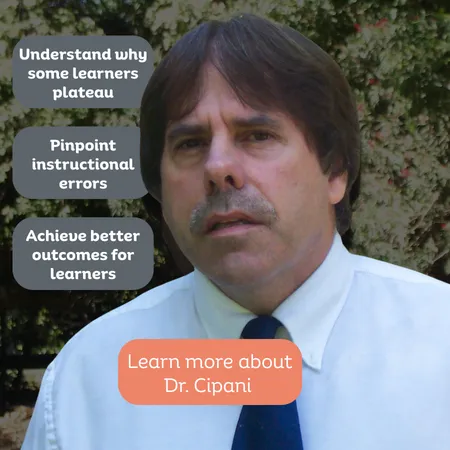
Ennio Cipani, Ph.D. is the author of Functional Behavioral Assessment, Diagnosis, and Treatment (2018, 3rd edition) which was ranked #1 in the 10 best behavioral psychology textbooks by wiki.ezvid.com (May, 2020). For further information, a description of its unique content is provided at the following link:
Ennio was a “psychologist who made house calls;” he and his behavioral staff provided on-the-spot training of parents and teachers on specifically designed contingency interventions for the referral problems. Many of his real-life cases in homes and schools are chronicled and delineated in his aforementioned ranked textbook as well as a freely available online exposition of the topic of consequences, Punishment on Trial (Cipani, 2004).
Reserve Your Spot Now — Limited Seats Available!
Don't miss this opportunity to level up your instructional design skills and prevent wasted training time. Perfect for BCBAs supervising RBTs, language program designers, and clinicians ready to improve learner outcomes.
Date: Available March 4, 2026
Time: 1 pm eastern
Duration: 1 hour
CEUs: 1 General CEU
Asynchronous Event: Register now, watch any time after the release date

© 2024 Master ABA - All Rights Reserved